

Your content can’t rank if search engines can’t find or understand it.
It doesn’t matter how insightful your blog post is. If Google’s bots can’t crawl or index it properly, it won’t show up. Crawling and indexing in SEO are what make visibility possible in the first place.
And yet, this is the step many people skip past.
Before we even talk about rankings or visibility, let’s unpack how crawling and indexing actually work and what you can do to make sure your content gets seen and not buried.
What Is Crawling and Indexing in SEO?
Before your content ever reaches a search engine results page (SERP), it has to pass through two crucial steps: crawling and indexing.
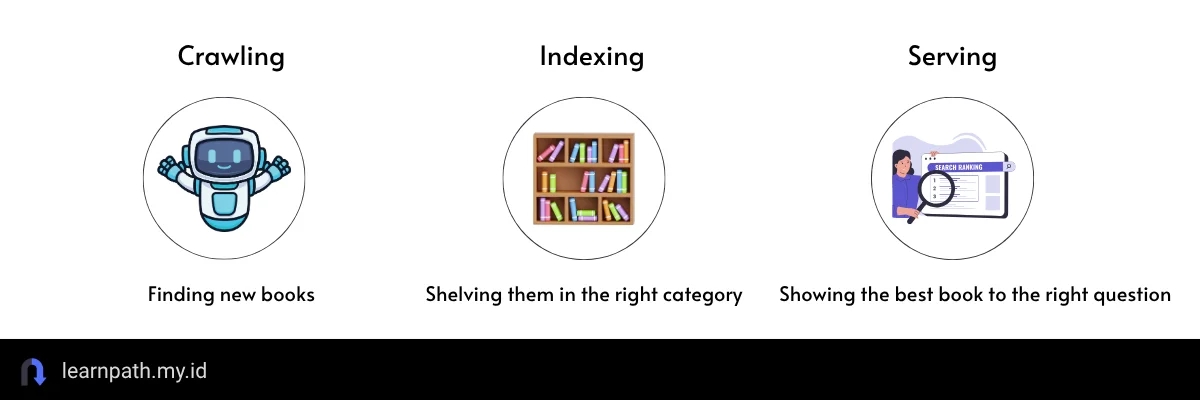
Crawling
Google sends bots (aka spiders or crawlers) to scan the internet, following links from one page to another. These bots gather data and bring it back to Google’s system.
If your website is linked from another page that’s already indexed, or submitted through a sitemap, Google’s crawler can find it.
What helps with crawling:
- Clear internal links.
- An updated XML sitemap.
- No unnecessary barriers like broken links or blocked pages.
Note
A crawler (also called a spider or bot) is an automated program used by search engines to scan web pages, follow links, and collect information for indexing.
Indexing
Indexing is how search engines store and organize your content. Once crawled, Google decides if the page is useful and adds it to its database or also known as the index.
If your page is indexed, it can be shown in search results. If not, it’s invisible to users.
What helps with indexing:
- Unique, high-quality content.
- Clean HTML structure (titles, headings, metadata).
- Avoiding “noindex” tags in your page settings.
What Happens After Indexing?
This brings us to the final step: serving.
When someone searches on Google, its algorithm scans the index and picks the most relevant pages to show. This step is called serving. It’s also when ranking happens (what shows up first, second, third, etc.).
You can think of the process like a library:
Quick Update from Google (2025)
At Search Central Live APAC 2025 in Bangkok, Google’s Search Advocate Gary Illyes shared some reassuring news that the fundamentals still matter.
AI may shape results, but crawling and indexing haven’t changed under the hood.
| Area | What You Need to Know |
|---|---|
| Crawling & Indexing Systems | AI results like AI Overview and Gemini Search use the same systems as traditional search. |
| Signals & URL Discovery | No new AI-specific signals. URLs are still found via sitemaps, internal links, or external pages like always. |
| Rendering & Indexing Engine | Caffeine (Google’s real-time indexing system) still powers all types of results, including AI-generated ones. |
Bottom line: You don’t need a new SEO playbook. If your site is crawlable, indexable, and useful then it’s already on the right path.
Real SEO Impact
Still wondering why crawling and indexing matter?
Let’s say you publish a guide titled “Best Budget Cameras for Vlogging.” You did your keyword research. You nailed the structure. But…
- Your sitemap wasn’t submitted to Google Search Console.
- Internal links didn’t point to the new page.
- It accidentally had a noindex tag in the header.
That page might never be indexed. It means: No impressions. No clicks. No ROI.
Your content can’t rank if search engines can’t find or understand it.
Also relevant: ToFu, MoFu, BoFu: Funnel Stages with Content Ideas
Other Search Engines Besides Google
While Google owns most of the market, other search engines use similar crawling/indexing logic:
| Search Engine | What Makes It Unique |
|---|---|
| Bing | Integrates with Microsoft Ads. Slightly different SEO signals. |
| DuckDuckGo | Doesn’t track users. No personalization in results. |
| Baidu | Dominates China’s search market. Prioritizes Chinese-language content. |
| Yahoo Japan | It remains popular in Japan. Operates separately from Yahoo.com. |
| Yandex | Russia’s main search engine. Has its own SEO ecosystem. |
Expert Note: SEO Basics Stay the Same
The platforms may look different, but the basics: crawling, indexing, and relevance stay consistent.
So even if you’re working across platforms like Etsy, Amazon, or TikTok’s search, understanding this process gives you a serious edge.
What You Can Do Next
Here’s a quick checklist to help your pages get crawled and indexed:
- Submit your sitemap to Google Search Console.
- Avoid “noindex” tags unless you mean to hide a page.
- Link to new pages from older, indexed content.
- Use clear structure: H1, H2, title, meta descriptions.
- Keep pages updated and error-free.
SEO starts before ranking. If your content isn’t crawled or indexed, it doesn’t exist at least to search engines. Once you understand how google search works, you can focus on what really matters: creating helpful, findable content that meets people right where they are.
Source:
Based on insights from the Digital Marketing & E-commerce course by Google.
Based on Search Central Live Deep Dive APAC 2025 – coverage via Search Engine Journal
Leave a Reply